
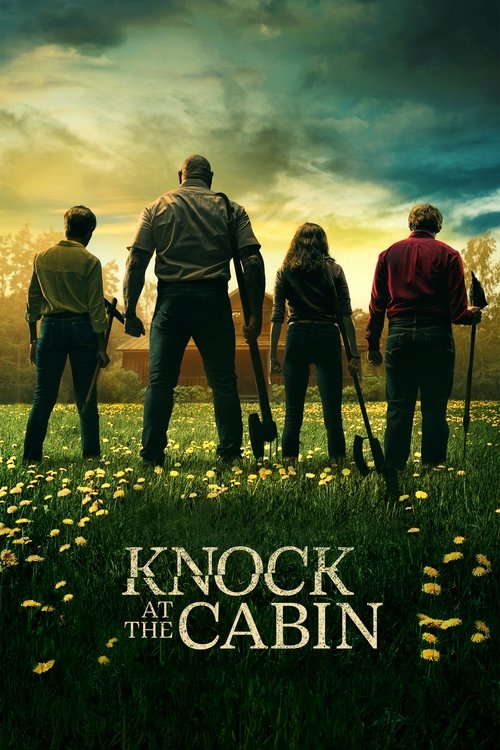
What happens at the end
By the last act, Redmond, Adriane and Sabrina are dead, and the TV has shown megatsunamis, a deadly new flu and hundreds of planes falling from the sky. Andrew has proved that Redmond was really Rory O’Bannon, a man who assaulted him in a bar years earlier, which convinces him the whole thing is a revenge scheme.
Leonard tells the family their time is nearly up, and that after his death they’ll have only minutes to decide. He cuts his own throat. Lightning, fires and more plane crashes follow.
Eric has come to believe the strangers. He compares them to the Four Horsemen of the Apocalypse. He doesn’t want Wen to grow up in a destroyed world, and he offers himself. He sees a vision of an elderly Andrew and an adult Wen thriving, and decides their family was chosen for a reason. Andrew, reluctantly, shoots him.
Andrew and Wen find the strangers’ truck in the woods, with material confirming everything they said. They drive to a crowded diner, where the news shows that the disasters have abruptly ended.
What it means
A test of faith, with a real answer. The strangers’ “common vision” sounds like madness, and the film gives Andrew every reason to doubt it, including proof that one of them had a personal grudge. The ending says the vision was real anyway. That’s the film’s biggest choice: it isn’t a story about whether to believe, but about what belief costs.
Love as the sacrifice. Eric’s choice isn’t about saving strangers. It’s about Wen growing up in a world worth living in. His vision of their future is what lets him go.
The darkness Night pulled back from. Night has said of himself, “I’m generally an optimistic guy, so I get to do really dark things.” The film goes to dark places, and then lets a family survive and the world keep turning.
How it differs from the book
In Tremblay’s The Cabin at the End of the World, Wen is killed by accident during a struggle, so the willing sacrifice never happens. Her fathers fight off or drive away the remaining strangers and refuse to sacrifice themselves, and the book leaves it unclear whether the world really ends.
Night’s version keeps Wen alive, has Eric choose to die and confirms the apocalypse was real. Co-writers Steve Desmond and Michael Sherman told Variety that Night “had a whole new vision for what the ending could be,” and that the book’s choices “may have been a little too much for a broader audience.”
Clues you missed
- The news. Every death in the cabin is followed by a new disaster on TV. It’s the film’s evidence, hiding in plain sight.
- The figure of light. As Redmond dies, Andrew, the skeptic, is the one who sees a figure of light.
- The four of them. Eric eventually compares them to the Four Horsemen. They arrive with makeshift weapons and insist they mean no harm.
- Eric’s concussion. Eric is hurt in the first struggle, which makes it easy to doubt what he sees later. The ending suggests he was seeing clearly.
- “Chosen.” Leonard says the family has been “chosen to make a horrible decision.” Eric’s last vision tells him why.
What Night has said
He never meant to follow the book. “From go, when this book came to me to produce, I felt very strongly that the story [couldn’t] go the way it was written,” he told Digital Spy. “It just can’t go that way for me. I have my feelings about that.”
Why the new title. “I am gonna do a different version of this book, I won’t call the movie the same,” he said. “The fans of the book can just have that and this is a different artist interpreting it differently.”
What the author said. Tremblay posted after the release: “That was the only ending filmed. The ending in my book is what I prefer.”
Where fans disagree
- Book ending or film ending? Tremblay prefers his. Slate‘s Sam Adams criticized the change, under a headline calling it “something worse than a twist.”
- Was it fair to Andrew? The film gives him real reasons to doubt, including Redmond’s identity, and then proves him wrong anyway.
- What kind of judgment is this? Whatever sent the visions demands a parent’s death to spare the world, and the film treats Eric’s choice as the right one.
- Plot holes. The Evening Standard‘s Charlotte O’Sullivan found “many plot holes.” The Observer‘s Wendy Ide called it “Shyamalan’s most contained and efficient picture in a while.”
Sources
- Knock at the CabinWikipedia (plot, production, reception)
- Knock at the Cabin quotesMNight.com, from Wikiquote (dialogue)
- Shyamalan and his co-writers talk about why they changed Knock At The Cabin’s endingWilliam Hughes, The A.V. Club, Feb. 4, 2023 (quoting Variety)
- Knock at the Cabin: Why Did M. Night Shyamalan Change the Ending?SYFY WIRE via Yahoo (quoting Digital Spy)
- Knock At The Cabin’s Author Got Candid About How M. Night Shyamalan Changed The EndingMike Reyes, CinemaBlend, Feb. 9, 2023