
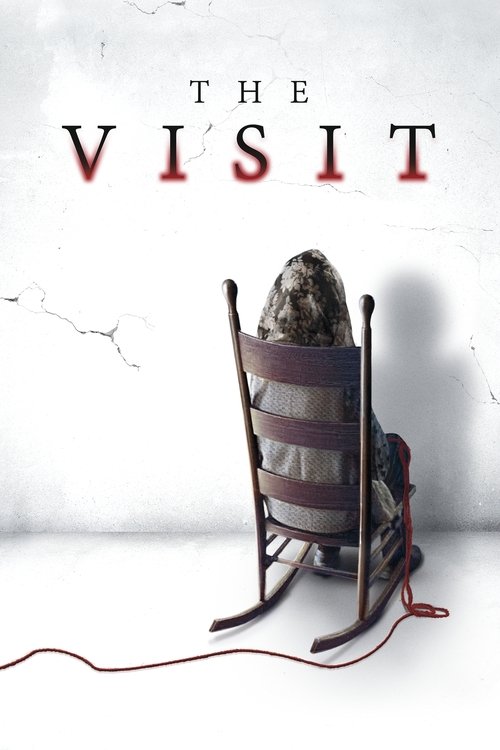
What happens at the end
After days of stranger and stranger behavior, Becca and Tyler call their mother and beg her to come get them. She asks where her parents are. Tyler angles the laptop’s webcam out the window toward the couple in the backyard, and Loretta panics. The people they’re staying with are not their grandparents.
The kids try to escape and find the body of Stacy, a woman the grandparents had counseled, hanging from a tree. The impostors catch them and make them play Yahtzee.
Becca slips into the basement, the one room they were told never to enter, and finds the decomposed bodies of the real grandparents, along with uniforms from the psychiatric hospital where they worked. The impostors are patients who escaped, killed them and took their identities.
Pop Pop locks Becca in a bedroom with Nana, who attacks her, and smears Tyler’s face with a soiled diaper, playing on his germophobia. Becca kills Nana with a shard of broken mirror, then goes after Pop Pop in the kitchen. When he gets the upper hand, Tyler knocks him down and kills him against the refrigerator door. Outside, their mother and the police are waiting.
Later, Becca asks Loretta what happened with her parents. Loretta tells her about a terrible argument the day she left, and admits she ignored them when they tried to reach out. She says reconciliation was always possible if she’d wanted it, and asks her kids not to hold on to resentment toward their father. Becca decides to include footage of him in her documentary after all.
Over the credits, back home, Tyler records a freestyle rap about the whole ordeal while Becca watches, approving.
What it means
The fear of getting old. Night told Bloody Disgusting: “The subject of the piece is fear of getting old, which is a variation on our fear of dying.” Becca’s “there’s something wrong with Nana and Pop Pop” gets the answer “They’re just old!” The film plays on how frightening aging can look to a kid, and then reveals it was never about age at all.
The family that wasn’t there. Loretta hadn’t spoken to her parents in 15 years. That silence is the only reason the trick works: the kids had never seen their real grandparents. The ending’s reconciliation talk is the film’s answer to the horror: lost time with family can’t be made up.
Forgiveness. Loretta tells her kids that she could have made peace with her parents if she’d wanted to, and that they shouldn’t carry anger at their absent father. Becca, who refused to film him, puts him in the documentary. It’s the film’s real ending.
Clues you missed
- No family photos. As Yahoo’s Ethan Alter points out, Loretta has no pictures of her parents around.
- The train station. Strangers hold a sign with the kids’ names, and the kids accept them because they want to.
- The basement rule. The kids are told never to go down there.
- “I used to be an actor.” The A.V. Club notes that strangers keep telling the kids they used to act, including the train conductor. The whole visit is a performance.
- The visitors. The A.V. Club notes that neighbors drop off food while the impostors are away. Stacy, who brings a blueberry cobbler, is never seen leaving.
- Each blames the other. Pop Pop says Nana is “sundowning,” and Nana says Pop Pop is incontinent. In hindsight, two patients covering for each other.
What Night has said
A film he had to make his own way. Wikipedia notes he paid for The Visit himself, borrowing $5 million against his home. Every studio passed on the first cut. A second cut went so far the other way that it became a comedy, and he finally found the balance and cut it as a thriller. Universal released it.
Found footage, his way. “You know I storyboard every shot of my thrillers in general. In this one, I had to put it in the screenplay,” he told Bloody Disgusting. “I can walk away and say, ‘The Visit is one hundred percent me.’”
Why the kid holds the camera. On set, “I look over, and Ed is there, and I’m like, ‘Ed, why don’t you just hold the camera?’” Ed Oxenbould, who plays Tyler, “was so proud that day.”
Where fans disagree
- Is it fair to its villains? Yahoo’s Ethan Alter wrote that “there’s something deeply unpleasant about the way he’s using the mentally ill as routine horror-movie boogeymen.”
- Comedy or horror? Night cut it both ways before landing on a thriller, and it still plays as both. Manohla Dargis in The New York Times called it “an amusingly-grim fairy tale” and compared it to Hansel and Gretel.
- That rap. Tyler’s freestyle over the credits is either the perfect release or the strangest last note in Night’s filmography.
- The comeback. The Rotten Tomatoes consensus called it “a welcome return-to-form.” The Guardian‘s Mike McCahill called it “dull, derivative and flatly unscary.”
Sources
- The Visit (2015 American film)Wikipedia (plot, production, reception)
- The Visit quotesMNight.com, from Wikiquote (dialogue)
- Spoiler Space: The VisitIgnatiy Vishnevetsky, The A.V. Club, Sept. 10, 2015
- Let’s Talk About the Twist in M. Night Shyamalan’s ‘The Visit’Ethan Alter, Yahoo, Sept. 11, 2015
- ‘The Visit’: M. Night Shyamalan and Jason Blum Talk Overcoming Criticism of Past Projects, Low Budget Horror, and Fear of DeathBloody Disgusting