
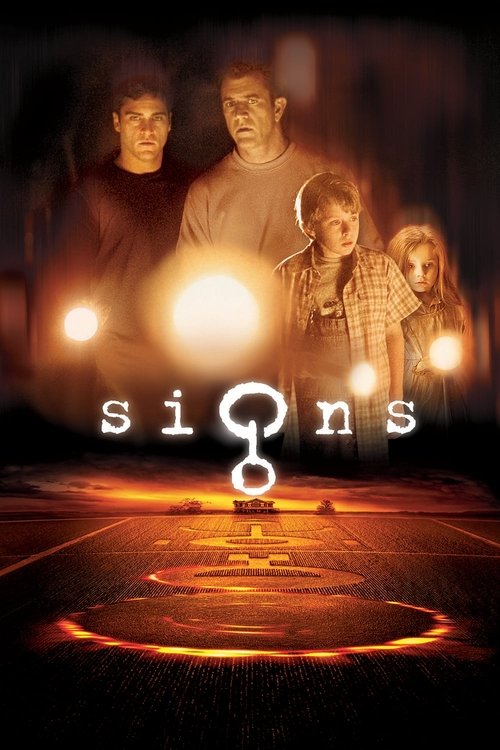
What happens at the end
The aliens break into the house, and the family hides in the basement overnight. Morgan has an asthma attack and there’s no medicine, but he makes it to morning. The radio reports that the aliens have suddenly left Earth, as if something frightened them away.
Then the alien that had been locked in Ray Reddy’s pantry, the one whose fingers Graham cut off, comes into the house and grabs Morgan. It sprays him with toxic gas from its wrist.
Graham remembers the night his wife, Colleen, died after a traffic collision. Her last words were: “Tell him to see. Tell him to see. And tell Merrill to swing away.” He looks at Merrill, a failed minor league ballplayer, and the bat on the wall. “Swing away, Merrill.”
Merrill fights the creature. They discover water is toxic to it, and Merrill smashes the glasses of water Bo has left around the house, weakening the alien. A final blow to the head spills water on its face and kills it.
Outside, Graham gives Morgan his medicine and realizes Morgan’s constricted lungs kept him from breathing in the poison. Graham credits a higher power. Months later, the family has recovered, and Graham is back in the church.
What it means
Two kinds of people. Earlier, Graham lays out the film’s question to Merrill: some people see “signs” and “miracles,” and others think people “just get lucky.” At the time, Graham, a former Episcopal priest who quit after Colleen’s death, is firmly in the second group. He tells Merrill her last words were just “the nerve endings in her brain” firing. The ending is the film answering him.
“Tell him to see.” Colleen’s words come true literally. Graham has to see the bat, the glasses and the connection between them. Night told The Ringer the glasses are a question of openness: “Do you see the glasses of water around you to save you at that moment if you’re not open to seeing the glasses of water around you?”
It was personal. Night calls his films “journal entries of where I am in my life,” and he said Graham’s position was his own at the time: “I want to believe. I remember, I want proof. That’s where I was, and where he is.”
Not a sermon. “I’m not religious at all,” Night said. “It wasn’t about endorsing or advocating for any specific religion.” /Film reads the ending the same way: it asks you to reach your own answer.
Clues you missed
- Bo’s water. All film long, Bo leaves half-drunk glasses around because her water always tastes “contaminated.” The family treats it as a quirk.
- Merrill’s bat. It hangs on the wall, a relic of his minor league career.
- Morgan’s asthma. It’s a constant worry, and in the end it’s what protects him.
- Reddy’s warning. Ray Reddy, the veterinarian who caused Colleen’s death, tells Graham he thinks the aliens avoid water, and heads for a lake.
- The couch conversation. Graham’s speech about luck and coincidence is the whole film in one scene.
- Colleen’s words. “See” and “swing away” sound like nonsense when Graham first repeats them. They’re instructions.
What Night has said
Why the theme took over. “When I understood that that’s what the movie was about, it filled everything,” Night told The Ringer about the couch scene. In a film like this, “every line, every choice you make spreads through the movie and affects everything.”
What belief is. “All we’re actually believing is that we have more agency than we truly believe.”
Where it started. According to Wikipedia, Night described the concept as “the combination of two ideas”: a family finding a crop circle on their property, and an end-of-the-world story.
Where fans disagree
- Faith or coincidence? The film lets Graham decide it’s faith. It never proves him right.
- The water. /Film’s Nick Staniforth asks, “should the intruders not have considered such an issue when visiting a planet that’s over 70% water?” One fan theory says the water was contaminated. Even he concludes “perhaps the best option really is to just ignore this one issue.”
- Did Night ditch the payoff? Roger Ebert, who liked the film: “At the end of the film, I had to smile, recognizing how Shyamalan has essentially ditched a payoff,” adding that “payoffs have grown boring.” A. O. Scott wrote that Night “never gives us anything to believe in, other than his own power to solve problems of his own posing.”
- A family film, not an alien film. Bong Joon-ho cited Signs as an inspiration for The Host because it “focused on the Mel Gibson’s family, not on the aliens.”
Sources
- Signs (2002 film)Wikipedia (plot, production, reception)
- Signs quotesMNight.com, from Wikiquote (dialogue)
- M. Night Shyamalan Talks ‘Signs,’ Twists, and Crop-Circle TattoosTim Greiving, The Ringer, July 30, 2020
- Signs Ending Explained: Swing AwayBJ Colangelo, /Film, Nov. 8, 2021
- Why The Aliens In M. Night Shyamalan’s Signs Make No SenseNick Staniforth, /Film, July 21, 2025