
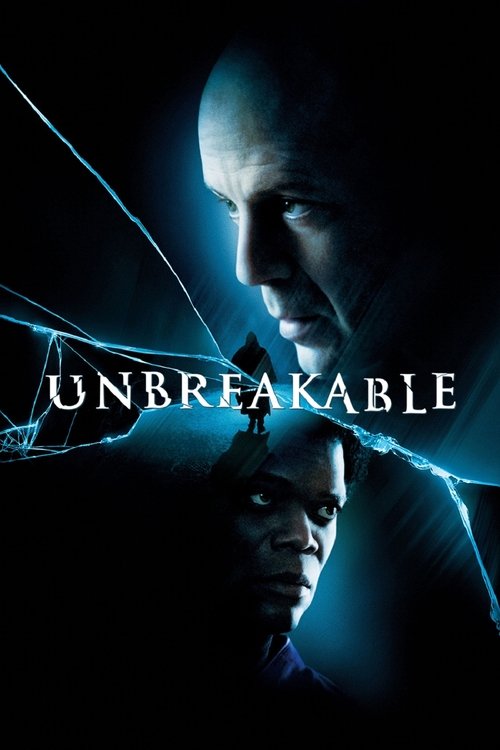
What happens at the end
David finally uses what Elijah has been telling him about. He follows a janitor who has broken into a family’s home, killed the father and is holding the mother and two children captive. David frees the children, gets pushed into a pool and nearly drowns before the children pull him out. He strangles the janitor, but the mother is already dead.
He comes home with a sense of purpose and reconnects with his wife, Audrey. The next morning, his son Joseph sees a newspaper sketch of the anonymous hero, recognizes his father and tearfully promises to keep his secret.
David meets Elijah’s elderly mother, who explains the difference between villains who fight heroes with strength and those who use their minds. Elijah asks David to shake his hand. At the touch, David sees Elijah’s crimes: the “accidents” he caused, including the Eastrail 177 crash, to find his hero.
Elijah says now that David’s identity is known, he knows his own. The kids used to call him “Mr. Glass,” and that’s who he is. Title cards say David told the police and Elijah was committed.
What it means
A man looking for his place. Elijah’s whole life is in one line: “Do you know what the scariest thing is? To not know your place in this world, to not know why you’re here.” Finding David gives him an answer. The answer is that he’s the villain, and he’s relieved: “I’m not a mistake!”
A hero accepting himself. /Film reads the ending as David admitting what he always half-knew: he’s never sick, he’s strong, he senses danger. The real payoff isn’t Elijah’s reveal but the morning with Joseph and the newspaper, when David’s son finds out he was right all along.
Opposites. As Elijah says, you can tell the archvillain because “he’s the exact opposite of the hero! And most times they’re friends.” David can’t be broken. Elijah breaks constantly. Each one needed the other to find out who he was.
A story told like a comic. Wikipedia notes that Night built the film on a comic’s three-part shape, the hero’s birth, his fight with ordinary criminals, and a final battle with his archenemy, and chose to tell only the first part: an origin story.
Clues you missed
- The colors. David is tied to green and Elijah to purple, in clothes, wallpaper, bed sheets and even Elijah’s note. Samuel L. Jackson suggested Elijah’s purple.
- The criminals in color. The people whose crimes David senses each wear one bright piece of clothing, red or orange, against a dark, muted palette.
- Glass everywhere. Glass motifs follow Elijah through the film, and scenes are framed through reflections and doorways like comic panels.
- The note on his car. After the memorial, David finds a note asking how long it has been since he was ill. It’s from Elijah, who has been studying him from the start.
- Water. David’s one weakness, Elijah tells him, is water. He nearly drowned as a child, and he nearly drowns in the pool at the end.
- “Most times they’re friends.” Elijah says it about comic books. He’s describing himself.
What Night has said
The ending was always the handshake. Night told Entertainment Weekly‘s oral history of the film that there was never an unfilmed version in which David didn’t shake Elijah’s hand and learn the truth by touch. He also said he’d always wanted a trilogy.
A different last image. According to /Film, an early script ended with David stepping into a crowd of “ordinary people, walking on an ordinary street, in an ordinary city.” Disney’s Nina Jacobson told EW, “The hero walking away from the villain always troubled me.” The film ended with title cards about Elijah’s fate instead.
What a twist should do. “I think the greatest twists are when things change fundamentally,” he told Creative Screenwriting in 2015. “In Unbreakable what you thought you saw was a superhero becoming a superhero.”
It was sold as something else. Wikipedia notes Night wanted to market it as a comic-book movie, while Touchstone preferred to sell it as a thriller in the vein of The Sixth Sense.
Where fans disagree
- The title cards. The Rotten Tomatoes consensus says, “With a weaker ending, Unbreakable is not as good as The Sixth Sense.” Roger Ebert liked the film but was disappointed by the ending.
- Ahead of its time or just early? Time called it a “relatively quiet, subtle and realistic look at the pressures that come with being a superhero,” and Quentin Tarantino later called it a “brilliant retelling of the Superman mythology.”
- Was that really the end? For 16 years it seemed so. Spoilers for SplitSplit ends with David Dunn in a diner, and Glass (2019) brings David, Elijah and Kevin Wendell Crumb together.
Sources
- Unbreakable (film)Wikipedia (plot, production, themes, reception)
- Unbreakable quotesMNight.com, from Wikiquote (dialogue)
- The Original Ending To Unbreakable Left More Questions Than AnswersSandy Schaefer, /Film, Dec. 6, 2021 (quoting Creative Screenwriting and EW’s oral history)
- Unbreakable Ending Explained: Accepting The Powers WithinBJ Colangelo, /Film, Oct. 18, 2021
- Split (2016 American film)Wikipedia (the diner scene)